

Kokoda - Day 2
Updated: Jul 17
Hoi to Isurava
Distance: 15.1 km
Walking time: 7 hours 4 mins
Elevation profile:

Day 2 started the same way it did every day. Me giving up on pretending I could sleep and arising around 4 am. Quietly packing my gear and ensuring everything was out of the tent before breakfast. At 5 am, Peta would walk the campsite with a small bluetooth speaker, playing inspirational music in lieu of an alarm clock for those lucky enough to still be asleep.
The morning routine was pretty simple. Wake at 5 am, pack your gear, and head to breakfast in the same hut you had dinner in the previous evening. Whilst we were eating breakfast, an industrious team of porters and helpers would disassemble the tents, pack them away, and then start walking to the next campsite.
Breakfast was usually the same each morning. Crackers and spreads in lieu of toast with tea or coffee, cereal moistened with powdered milk, and sometimes a bowl of canned mixed fruit to mix in with the cereal. On occasion, we were spoilt with miniature pancakes, which were joyfully welcomed. Once breakfast was done, it was a line-up to wash our utensils,
brush the teeth, and do final faffing, and then get ready to trek. On most days, we started walking between 6.15 am and 6.30 am, the only exception being Day 3 when, due to the length of the day, we set off in the dark at 5.15 am.
Setting off on day 2...all of us still feeling pretty refreshed and ready. That was about to change

Our guide, Peta, had notified us at breakfast that we ought to postpone putting our boots on until after we had forded the small creek that split the village of Hoi in two. So on went the sandals and a wade through shin-deep cold water to start the day. We sat down on the other side of the creek, dried our feet, applied Vaseline to our soles, put our socks and boots back on, and then headed off.
The terrain, as it was for most of the morning, followed a trail that was definitely single file and seemingly got steeper as the day progressed. The morning mist gave an indication of the moisture in the air and the lack of wind. In fact, the lack of wind was one of the meteorological factors I noticed over the entire eight days. Its continued absence amplified the impact of the humidity and temperature

Our first stop for morning tea was in a small village decimated by a massive storm that had caused havoc in the week before we arrived in the area. Here was a clear example of its impact on both nature and man-made structures: a hut shorn of its walls and roof by the ferocity of the winds that had swept through the area

For some reason, there were dogs aplenty throughout the week. Normally looking emaciated and knocking on their makers door. This one seems deep in thought as it peered out into the mist covered void of the valley below us

Morning tea break. As the clouds broke the view afforded us down the valley was pretty special. Morning tea was usually sweet biscuits and a chance to catch our collective breaths

Aside from morning tea, there were periodic pauses in the walking each day to either bring the group back together (we were often strung out over 400–800 metres along the track) or because Peta wanted to inform us of the military significance of that particular part of the trail.
Although it was only Day 2, Marty was already setting an envious example, having the innate ability to sleep wherever he lay. In addition, he somehow managed to maintain the most ridiculously clean pair of boots throughout the entirety of the trek

Occasionally, and usually on the fringes of a nearby village, we would come across entrepreneurial villagers who had carted cans of soft drink from a trading store at either Kokoda or Port Moresby and were now selling them at a much higher premium to trekkers willing to pay the asking price, which was usually 10 Kina, or the equivalent of AUD$4 or £2. Given the logistics involved in transporting them to such a remote area, this was not, in my mind, an excessive premium. Here, the villager had even gone to the trouble of covering his table with leaves to make his offerings all the more presentable. Whilst barely cooled by the river water in which they sat, the drinks were nonetheless very welcome. The terrain at this point was probably the driest we would experience during the entire trek

Occasionally we would be spat out from under the canopy of the jungle into open expanses of shoulder high grasses. Here, without the luxury of the jungle canopy to protect us, the full force of the sun and the resulting heat was fully felt
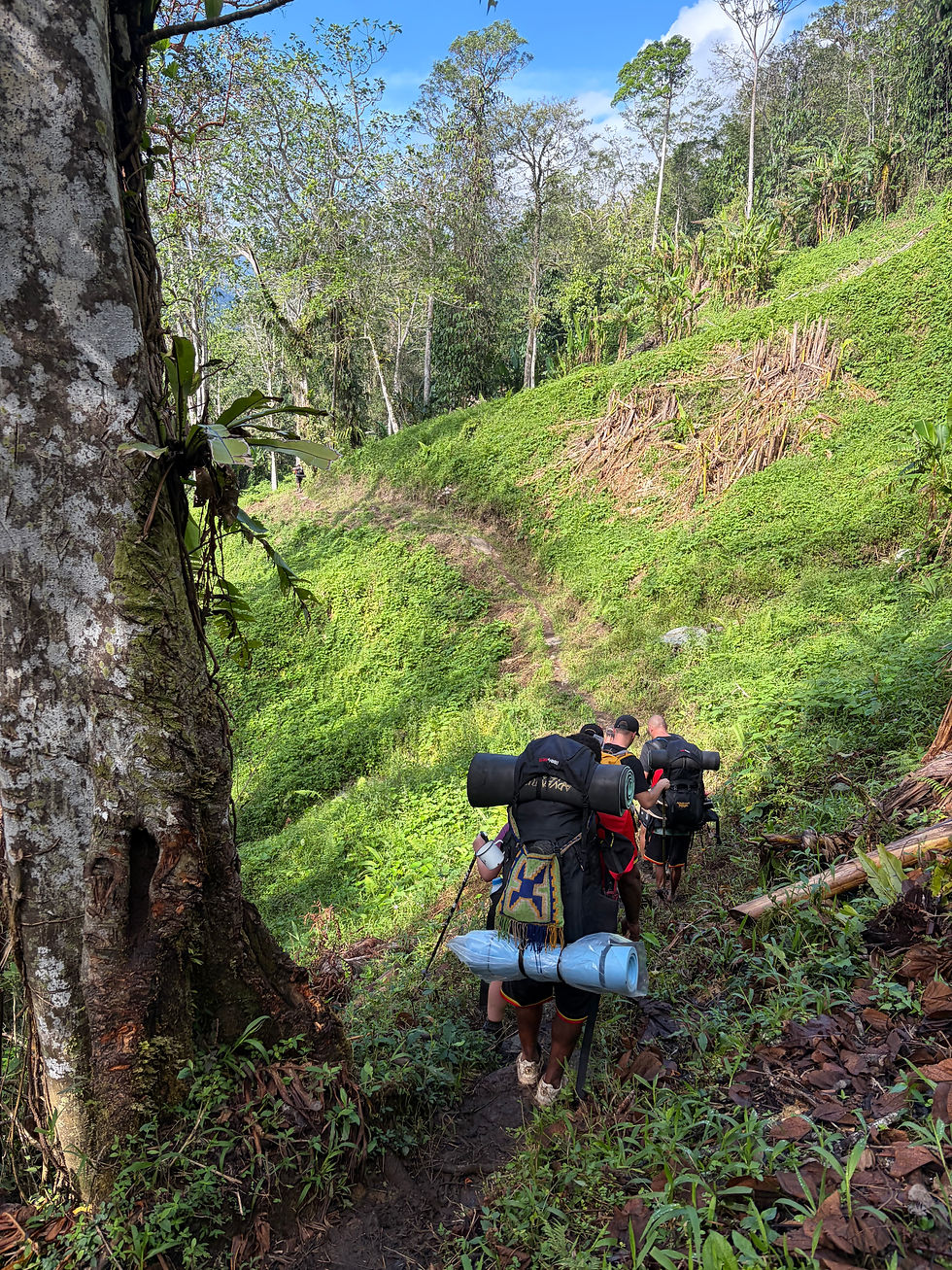
Those open spaces didn't last long, however, and we spent the bulk of nearly every day walking under the shadows of massive trees and equally massive foliage. Here, another creek crossing surrounded by lush vegetation that was to become a very common sight throughout the eight days

As the day progressed, the terrain became steeper and more technical. Although we were ostensibly climbing for most of the day, the pace was pretty much the same going up a hill as it was going down, due in no small part to the technical nature of the trail. Those who had paid for porters were afforded the security of having their porter walk behind them on steep descents, holding the trekker's backpack to help ensure they didn't fall or slip. Going uphill, the porter would normally lead the way, showing the steps the trekker should follow or, on occasion, pulling them up a particularly steep section

Our objective on day 2 was campsite at Isurava village where there is the most prominent memorial on the trail to the Kokoda campaign


The local fauna never failed to disappoint

The four columns of South Australian granite. Weighing just over 3.5 tonnes each, they were mined just outside Adelaide and then transported by truck to Melbourne. Shaped and engraved there, they were then loaded onto a train to Townsville and sent by ship from there to Port Moresby. Once in PNG, they were individually helicoptered to Isurava, where they now sit in situ as a memorial to those who fought and fell on the trail. Every ANZAC Day, there is a well-attended dawn service, drawing both trekkers who walk in and politicians and dignitaries who arrive by helicopter

Our campsite at Isurava. As with all our campsites, the tents were located closely together and erected by porters or carriers who had transported them from the previous campsite and would do the same again the next day.
Although seemingly robust, they didn't prove to be particularly fit for purpose when it rained. And rain it did.
Just as we were finishing dinner, the skies opened up. What started as a light pitter-patter on the flysheets of the tents became a constant drumbeat that lasted for most of the night, rendering those drying lines somewhat redundant.

The juxtaposition of this scene drew me to take the photo. On one hand, you have the traditional PNG village hut which is simple but functional. On the other, a windsock for the helicopter pad behind it, an obvious sign of the encroachment of modern life into a remote village

Those clouds were a portent of what was soon to become a very very wet evening

Isurava was one of the two campsites on the trail that offered us showers. Well, a shower. Which was ostensibly a tap about 6 ft up inside a small wooden booth offering cold mountain water to wash under.
Peta, our guide, had a natural affinity with the local trekking crew. Her high regard for them and passion for their well being was obvious from the moment we first met her upon arrival in Port Moresby. Here she talks to 'Boss Kuk'' (head chef)

We were settling down to dinner at the end of Day 2 when there was an almighty piercing shriek that I am pretty sure could have been heard back in Kokoda, two days’ trek away. One of the trekkers, Lisa, had wandered off to avail herself of the toilets. This little fella had decided he wanted to join her in the booth. Her husband, Grant, couldn’t have run quicker to see what the commotion was about—a commotion, to be fair, that was probably warranted

Day 2 also heralded in our first 'on track' injury. Lynda had somehow twisted her right knee badly. The initial prognosis (from everyone who wasn't a qualified knee specialist) was that she had severely strained or perhaps torn her medial ligament. Asking her husband Chris for his thoughts on her ability to carry on he turned to me and simply replied. ''She is one tough mudder. She'll be OK.'' Having torn a ligament in my left knee a few years back (water skiing on one ski at high speed into a mangrove tree is what did it) I had some understanding of the pain she was in. The difference back then was that I didn't still have 6 days to walk on one of the most formidable jungle trails there is. What followed was nothing short of inspirational.
We all settled into what was to be the wettest night of the trek
Comments