

Kokoda - Day 5
Updated: Jul 17
Efogi to Agulogo (via Menari)
Distance: 19.2 km
Walking time: 9 hours 17 mins
Elevation:

Shortly after the 5 am wake-up call, the lights came on and the group started to get ready for another day of self-flagellation. With a distinct lack of ambient light in the middle of a tropical jungle, the sky seemed very big and the stars very clear. It made you feel very small—a bit like camping in the outback

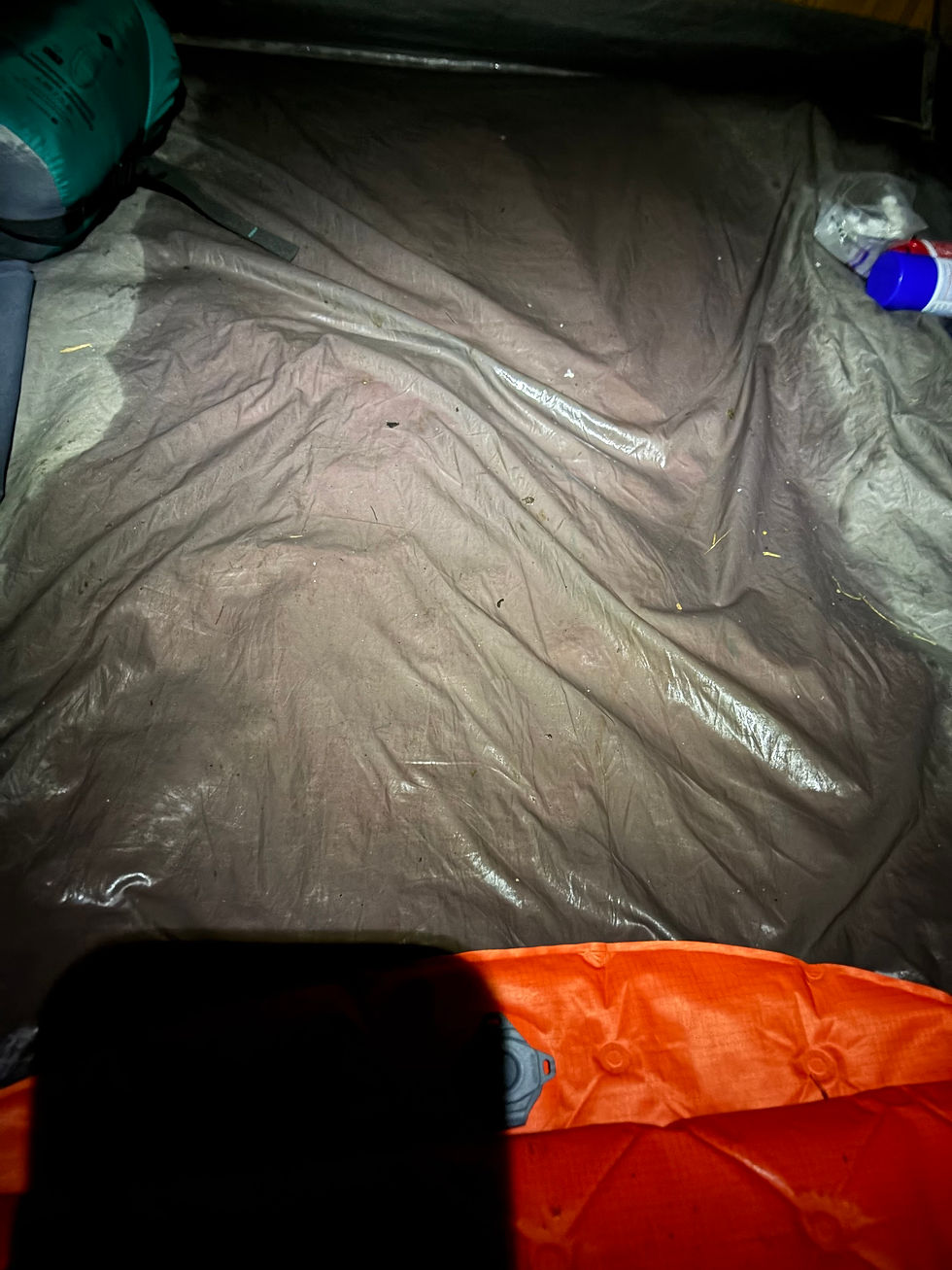
Another wet night and another night fighting the moisture inside the tent. The trekking company we had used was very good at most things. Tent provision wasn't one of them. In short, they (the tents) were not (imho) fit for purpose given how much dampness there was in the ground. Thankfully I had an air mattress between my sleeping bag and this collection of water. It was my experience that if your gear wasn't inside a waterproof vac bag or inside your rucksack overnight it was going to be sodden the next day
The trekking company had also advertised the availability of a "drying hut" at nearly every campsite. Ostensibly, it was one or two open fires under the shelter of an open-sided hut. Trekkers would dangle their sodden attire over the fires and place their boots beside the fire. My experience was that it was a massive trade-off between having partially dry clothes and clothes that reeked of wood smoke. The improvement in boot condition by morning was negligible. This was partly because, once the fires were no longer attended to and died out (usually around 11 pm), there wasn't a whole lot of drying going on.
My alternative was simply to wash the clothes I had worn during the day in the river at the campsite and leave them hanging outside my tent. Yes, they were still sodden in the morning, but being smoke-free, they were usually dry within an hour of walking—or they remained wet because it was raining. Much like the "clean your boots at the end of each day" scenario, the condition of clothes that had been hung in the drying hut usually changed within an hour of walking. The downside was that they reeked of smoke. Each to their own but I used the drying hut once and wouldn't use it again. Despite washing it three times since my return the trekking towel still smells of smoke.
"Drying hut"

For the eagle-eyed amongst you, you may have noticed an anomaly in the photo above. It wasn't just clothes and boots being dried. The dying embers of the fire also kept one of the village dogs warm during the evening.
Somewhat heartbreaking was the condition of all the dogs we came across during the trek. The consistency of their malnutrition was a sorrowful sight

Efogi had an airstrip. So am guessing if push came to shove and you wanted to be evacuated and could only afford a plane then this might be your option. Like all highland airstrips it is grass and like all highland airstrips very susceptible to the local weather

The importance of the porters was constantly reflected in their actions throughout the day. Assisting their trekkers down steep slippery sections of the trail such as this was well appreciated by those who had paid for the service. Creek No. 1,856 about to be crossed. (Mild exaggeration, but only just...or so it seemed)

The Seventh Day Adventist's certainly wanted to let you know of their influence. Often these boundaries were also marked by a collection of white stones to denote your entry or exit from their territory

Starting early each morning did have its benefits. The humidity and heat had yet to build up, the skies were usually clear, the air fresh, and often we were walking in the long shadows of the trees. Made it all relatively delightful. Ahead in the sunlight you can see the track cutting its way across the hill. That's where we were headed and that's where Chris and Lynda who had set off about an hour ahead of us were already at. Along with Mo who had gone with them

Walking paces. Another often-asked question: how did the group deal with the different paces and abilities?
As mentioned earlier, absolutely no one was allowed to walk ahead of Stansol. At the rear was the 2IC (second-in-command), Kyson, who basically didn't allow anyone to walk behind him. He was the sweeper, so to speak. Between those two, there were times when the group was stretched out over 500-1,000 metres. It doesn't sound like much, but that equates to about 30 minutes of jungle walking time. Sometimes more.
There was one exception to the Stansol rule. By the end of Day 4, it was clear that Lynda was battling so much with her knee that she made the decision, in collaboration with Peta, that she and Chris would start ahead of the group in the hope that we'd all be together for lunch. They would then leave earlier than the group after lunch and arrive at camp at similar times each night. This was a selfless decision on their part. Selfless because, in doing so, they were separating themselves from the group and thus missing the banter and everything else that comes with walking with others.
With them was Mo, who had begun the trek with a pre-existing condition of chronically poor knees. Mo, forever positive and cheerful, also set off early on this particular day, and every day thereafter, because her knees severely restricted her pace. For her, the walk was pretty much a solo bash along the trail, with only the presence of her porters to keep her company.
For the rest of us, we would normally pass the early leavers by mid-morning, if not earlier, and then rejoin as a group for lunch. Repeat the process after lunch and then arrive within an hour of one another at the final camp for the day.
Everyone was encouraged to walk at their own pace and, as the days unfolded, natural pockets of trekkers formed as people found their walking comfort levels. The banter in the group was normally at its peak soon after leaving camp in the morning or after lunch, and at its lowest when clambering up any one of the seven thousand four hundred and fifty-two impossibly steep, mud-ridden climbs.
By the end of Day 1, it was clear that any topic of conversation was open for discussion, usually in a very humorous and objective fashion. With Jenna usually leading the conversation.
Day 5 was a dramatic one for the group and served as a good reminder of how perilous the walk could be. As mentioned earlier, Lynda and Chris had set off ahead of the group. By mid-morning, we hadn't passed them, and I recall saying to someone that I was impressed by the pace they must be setting, especially given the state of Lynda's knee. Late that morning, we dropped down a very steep hill into a river crossing and still hadn't passed them. When we arrived at Menari for lunch, they were nowhere to be seen. The immediate assumption was that they had eaten and pressed on. That was soon clarified when the local villagers and trekking staff said they hadn't arrived at the village.
To cut a long story short, their two porters had inadvertently taken them off on a tangent from the main track and instead led them down a trail away from the group. What followed sounded horrific: declines so steep that they were on their backsides some of the time, and a couple of bridges that were crossed which were nowhere near as stable as those on the main trail and twice as high.
When their porters finally recognised their mistake and rectified it, the two of them arrived at Menari for lunch about two hours after the rest of us—and that's after having set off an hour before us. Needless to say, with a knee in the condition it was, those extra miles of arduous trekking were not what the doctor would have ordered.
Amongst everything else involved in the situation, it was a poignant reminder that in the jungle, even the best intentions can be waylaid by the environment and some incorrect decision making.
Every group has one. We were fortunate in that we had a few of them—people who have the innate ability, through their natural personality, to make you laugh. They bring a light-hearted approach to many situations and a refreshing honesty when appraising what's in front of them.
Jenna was one of those people. A dental assistant by trade, wife to Dammo and mother to children she was our very own unofficial group morale officer.

Grant (far left), of Go-Kart fame, had an encyclopaedic knowledge of films and quotes. The banter between him, Chris, and Glen when it came to discussing virtually any film ever produced was impressive to follow. Grant also likes to ski, so we had plenty to talk about.
Next to him stands Lisa (his wife and the now re-christened ''Pocket-Rocket'), and on the far right is Dammo. The latter, being an avid Geelong Cats fan, was automatically in my good books from the very get go. The three of them, along with Marty, were usually right up there behind Stansol when it came to setting the pace

As was her wont, Peta stopped a couple of times per day to talk passionately about the section of the trail we were on and its relevance to the campaign. Her emotional investment in the history of the track, the people, us as trekkers, and everything else to do with the trek was impressive and, at times, quite moving to witness.
She has completed the trek 12 times, and being a guide is not even her full-time occupation. Her normal day job is as a logistics manager at Bunnings on the Sunshine Coast, where they handle the delivery of 150 pallets every day. "Stuff" you learn when you walk and talk.
I suspect that, at times, guiding us must have been akin to herding cats. However, she did it without fuss and with a degree of compassion that was much appreciated. Her knowledge of the trail and the ongoing battles between June 1942 and January 1943 was on another level to anyone else's I have come across

The sheer scale of the jungle and our surrounds best exampled by this photo

One of the more challenging aspects of the walk. Let go of that chain, fall to your right and you were probably going to meet your maker. At least it was dry when we navigated this section

Probably the fittest set of couples on the walk. Looking annoyingly refreshed and happy despite the challenges of the trail. Remarkably clean too

Another history stop. Thankfully

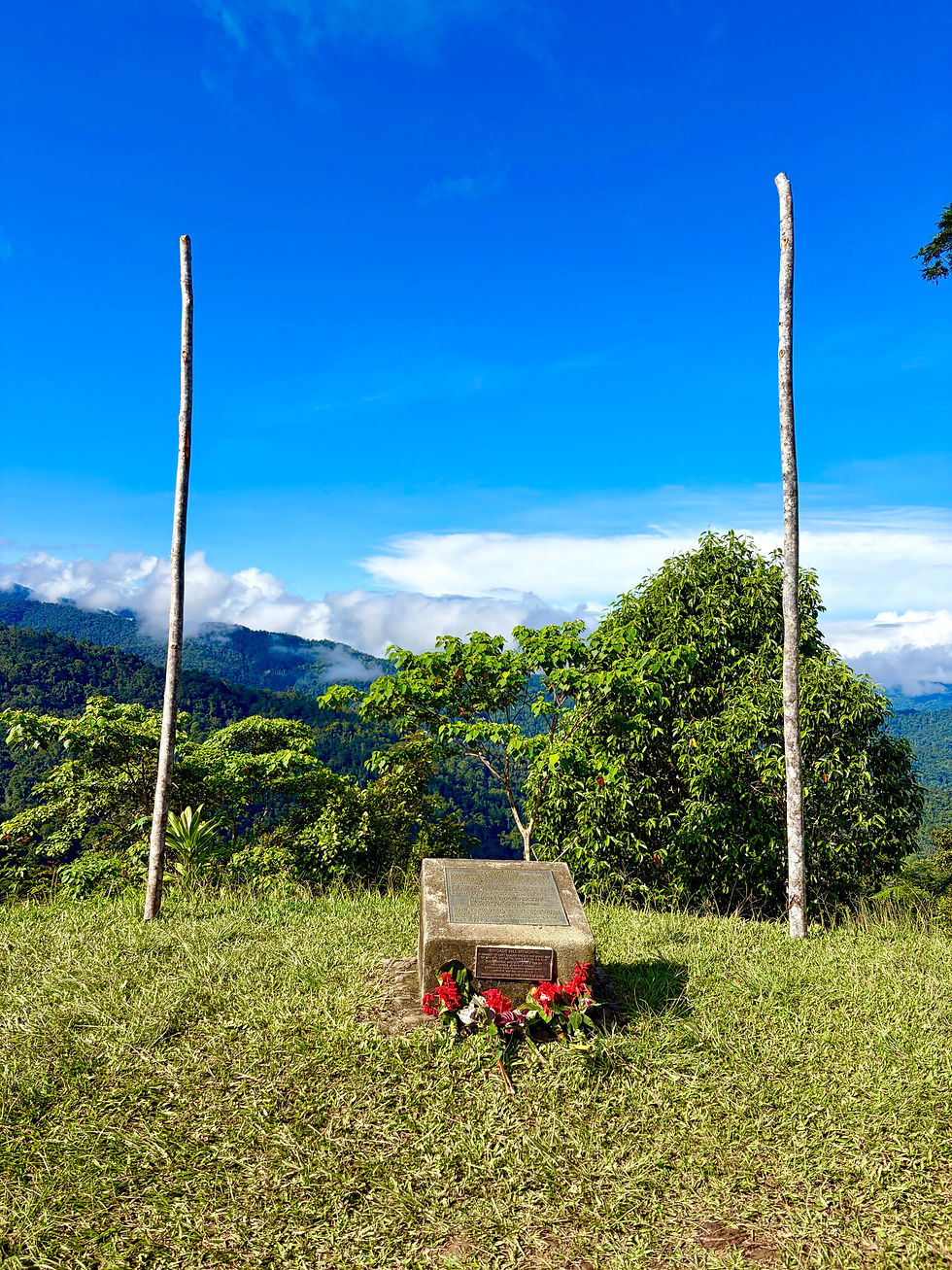
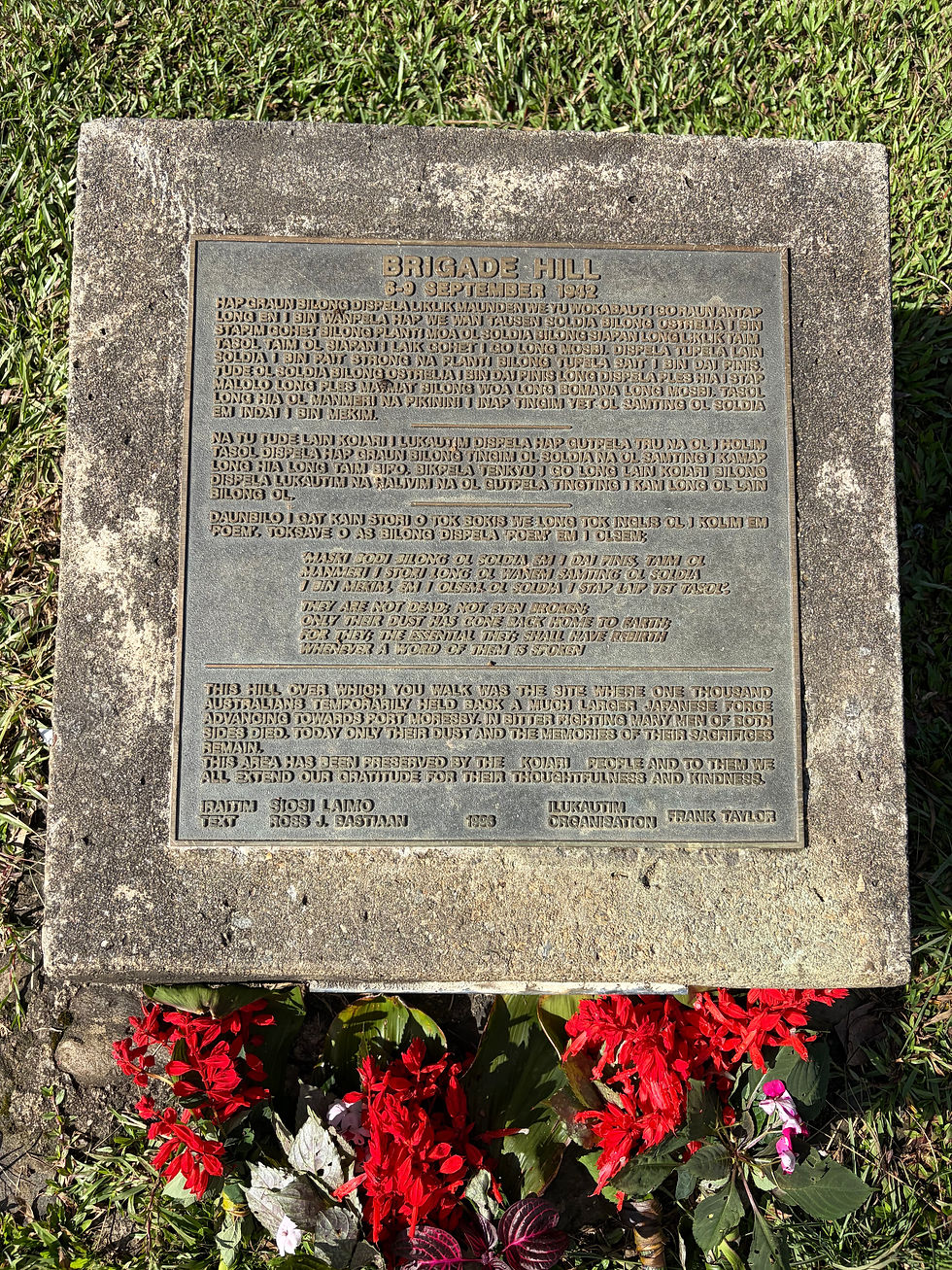
Mid morning break was atop Brigade Hill which sat on Mission Ridge. Site of one of the more ferocious battles of the campaign. The Australians, lacking artillery and heavy machine guns, needed to choose defensive positions carefully as they retreated against the oncoming Japanese forces – high ground, large enough to have three battalions (approx. 1000 men) dig in, where they could see the Japanese coming, and react when the Japanese manoeuvred to try and surround them. Ground where they could funnel the attacking Japanese onto the Australian guns, and wipe them out. Because if they didn't wipe them out, and if they did surround the Australians, the Aussies would have been, in the words of one Australian Army officer..'' fixed, flanked, and fucked''. And, if that happened, the track to Port Moresby would be open

Quite a few 'memory' sticks signify the losses incurred on the hill

Brigade Hill views. I am not a military strategist in any way shape or form. However if I was in charge of setting up a defensive position in any jungle I am pretty sure Brigade Hill would be close to the top of my choices. It afforded 360 degree views from atop its summit and the drop off on every side was very steep making it next to impossible to attack. The Japanese, as was their want, gave it a crack nonetheless

The day became wetter as we progressed and the trail more challenging. Especially on descents. This photo reminded me of the iconic photo from the campaign....


(Courtesy of History with Dave)
''This iconic World War II photograph above tells a story of courage, compassion, and unlikely brotherhood.
Pictured is a Papua New Guinean villager Raphael Oimbari a "Fuzzy Wuzzy Angel" guiding this wounded, blindfolded Australian soldier George Dick Whittington through the harsh terrain of the Kokoda Track during the 1942 Kokoda Campaign. Whittington later died in 1943 from bush typhus.
These local heroes were not trained soldiers. They were ordinary villagers who risked their lives to carry supplies to the frontlines and help evacuate injured Australian troops through rugged mountains and dangerous paths.
Nicknamed “Fuzzy Wuzzy Angels” because of their curly hair, these men earned the undying respect of the Australian troops they helped save. Their kindness, strength, and sacrifice left a lasting legacy in both Papua New Guinea and Australia.
Today, they are remembered not just as wartime helpers, as true heroes—symbols of humanity in the face of war.
Let us never forget their contribution. '' (credit for description to 'History with Dave'')
By day 5, everyones knees were taking a beating and knee braces along with Italian 400mg Ibuprofen were in high demand
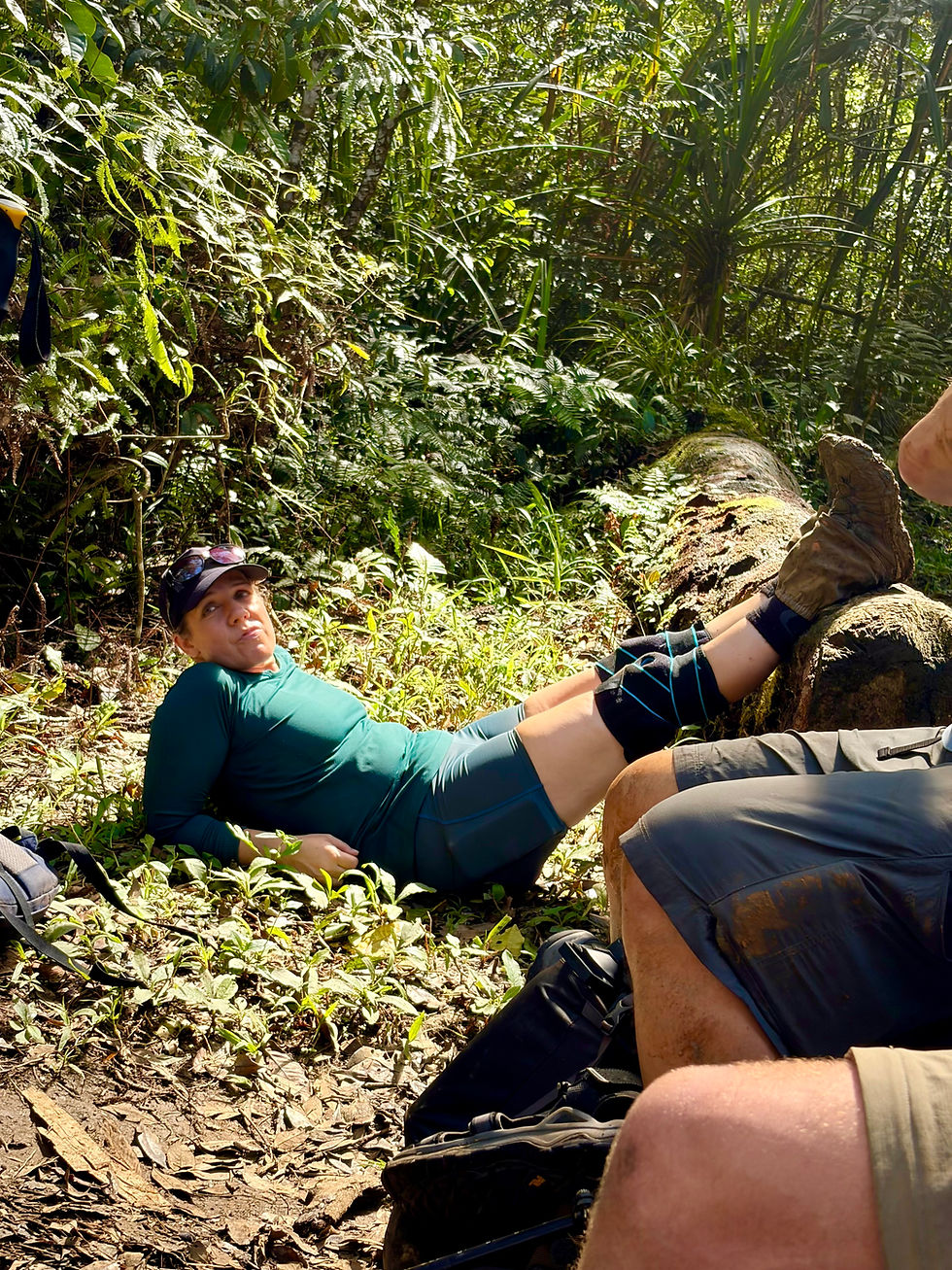
It wasn't just steep slopes and countless slippery tree roots that challenged us

One of the wider and more benign sections of the trail. Probably the widest section we had seen since setting off from Kokoda and the widest of the entire 8 days. A welcome relief it was too. Vegetation still as thick as ever

I mentioned earlier that footwear amongst the locals was optional. It was also creative. Coming the other way on this day was another group of porters and trekkers heading northwards. This porter had taken a unique approach to solving the issue of walking through mud for 8 hours a day. Shudder to think how sweaty those feet would be by days end
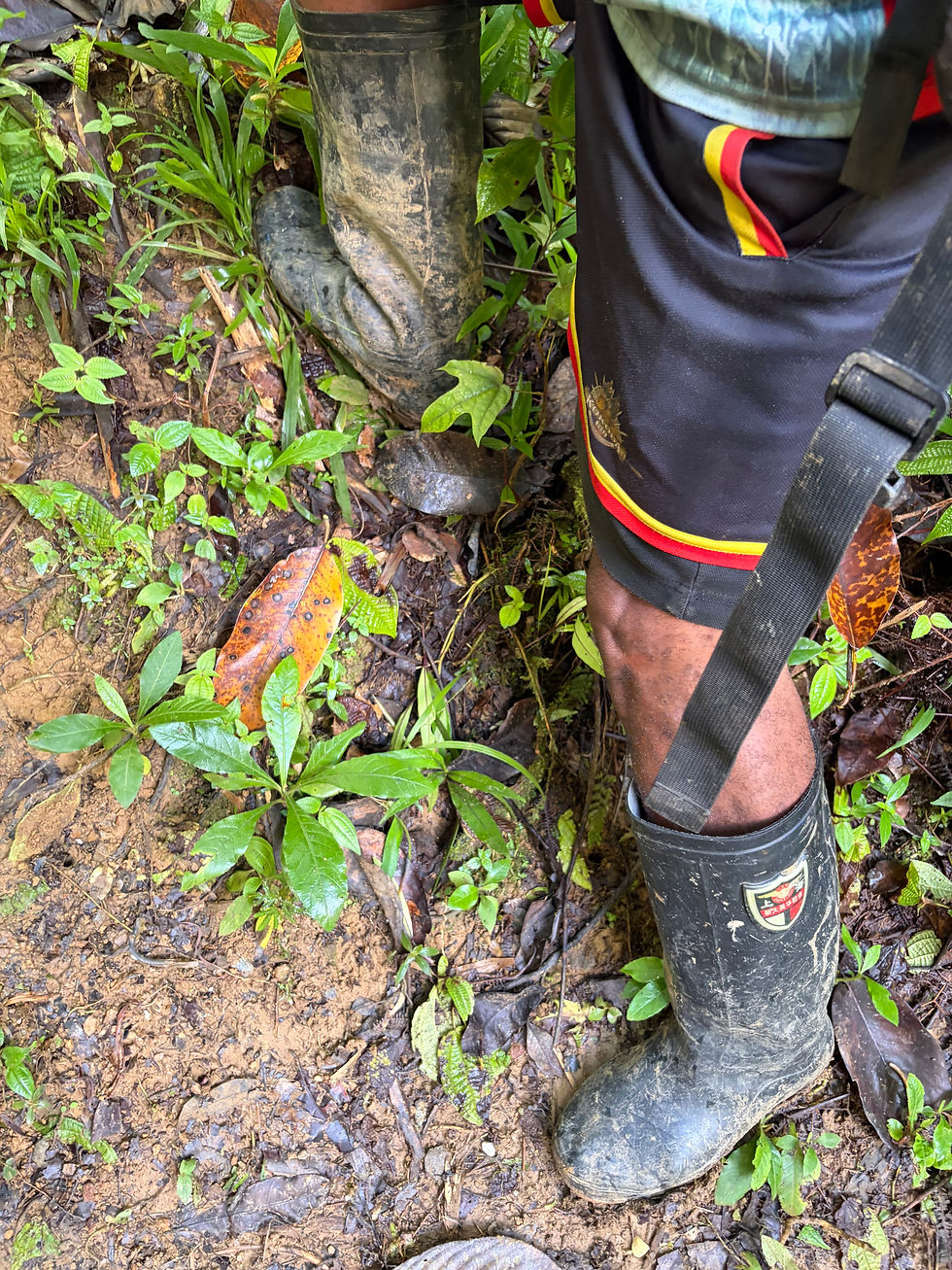
Local flora of the day. If fungus can be called flora. Any idea Mum?

Hardly visible, down in the valley is a trekking group from the same company that had started at Owers Corner and was heading north to Kokoda. They're waiting patiently for us to descend and cross the river before they attempt the slog-a-thon up the hill to where I was standing when taking this photo. Mind you, we all agreed that climbing up a hill was often more pleasurable than descending it given the nature of the mud and rocks and tree roots we had to navigate

Emerging from the jungle into the wide open expanses of Menari and its airstrip we were struck by the direct sunlight and heat which made the short walk to the centre of the village, and our lunchtime destination. somewhat harder than it should have been

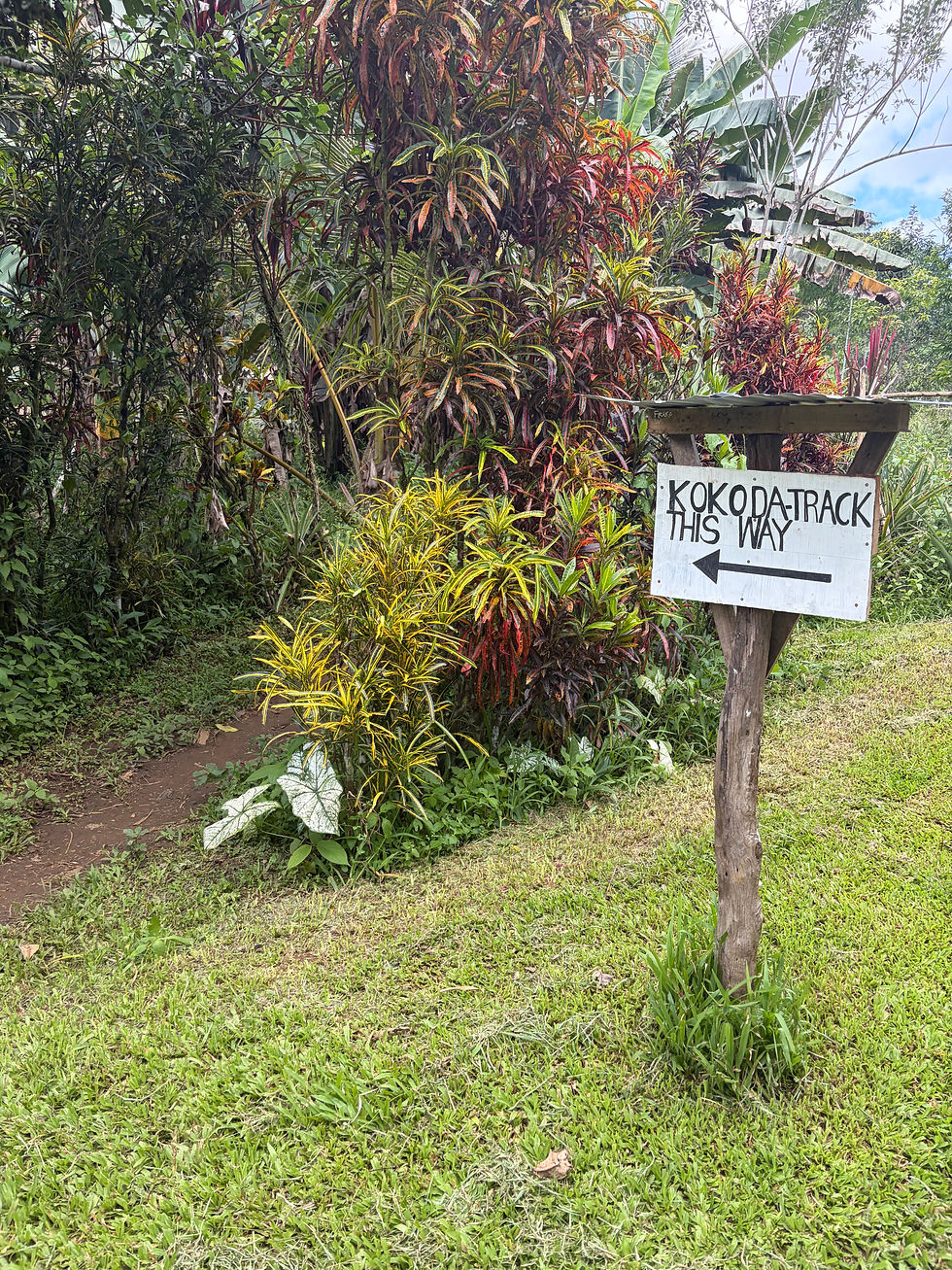
No GPS or maps required here. Simple signage did the trick. The irony of the directions wasn't lost on me moments later when we realised that two of our group were out there battling the demons after being guided off track
As always, entrepreneurial villagers (women in this case) put their wares on display for us to look at and potentially buy. Here, a collection of brightly coloured bilums are on sale

Marty at lunch in Menari assuming his favoured position. Lying flat. Either on his back or on his front. That's my air mattress he shelters under. At most prolonged stops we would take the opportunity to lay out the clothes and gear still wet in the hope of drying them before they were needed next. Probably the only positive from Lynda and Chris being detoured that morning was that our stop for lunch this particular day was a very long one indeed

The view post lunch from atop a hill looking back down to Menari. Always good to see where you have come from
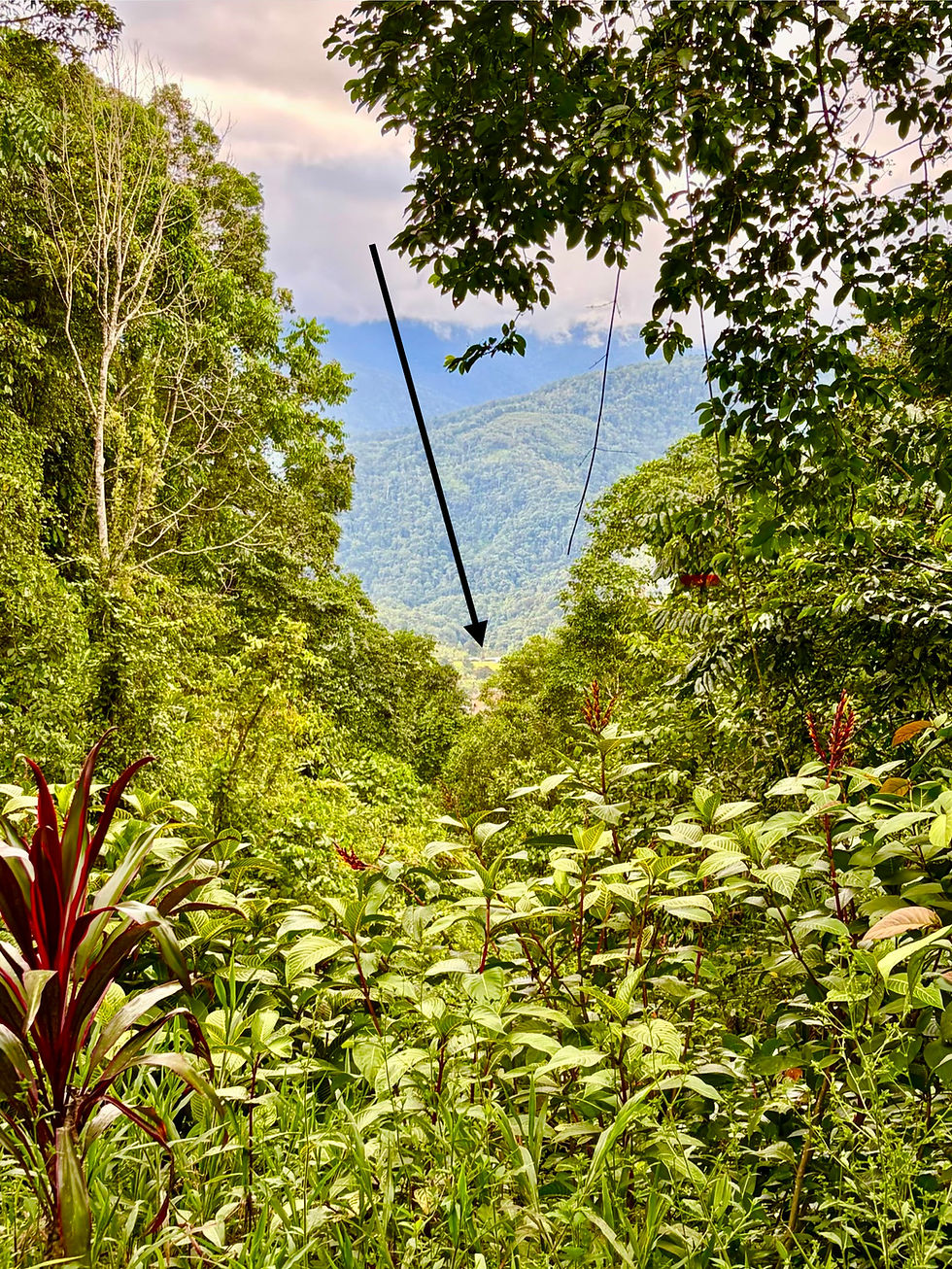
Another very clear sign that we were in SDA territory. I am in no way religious but I am confident enough to wager a hefty lump that Corinthians does not specifically mention Betel Nut.

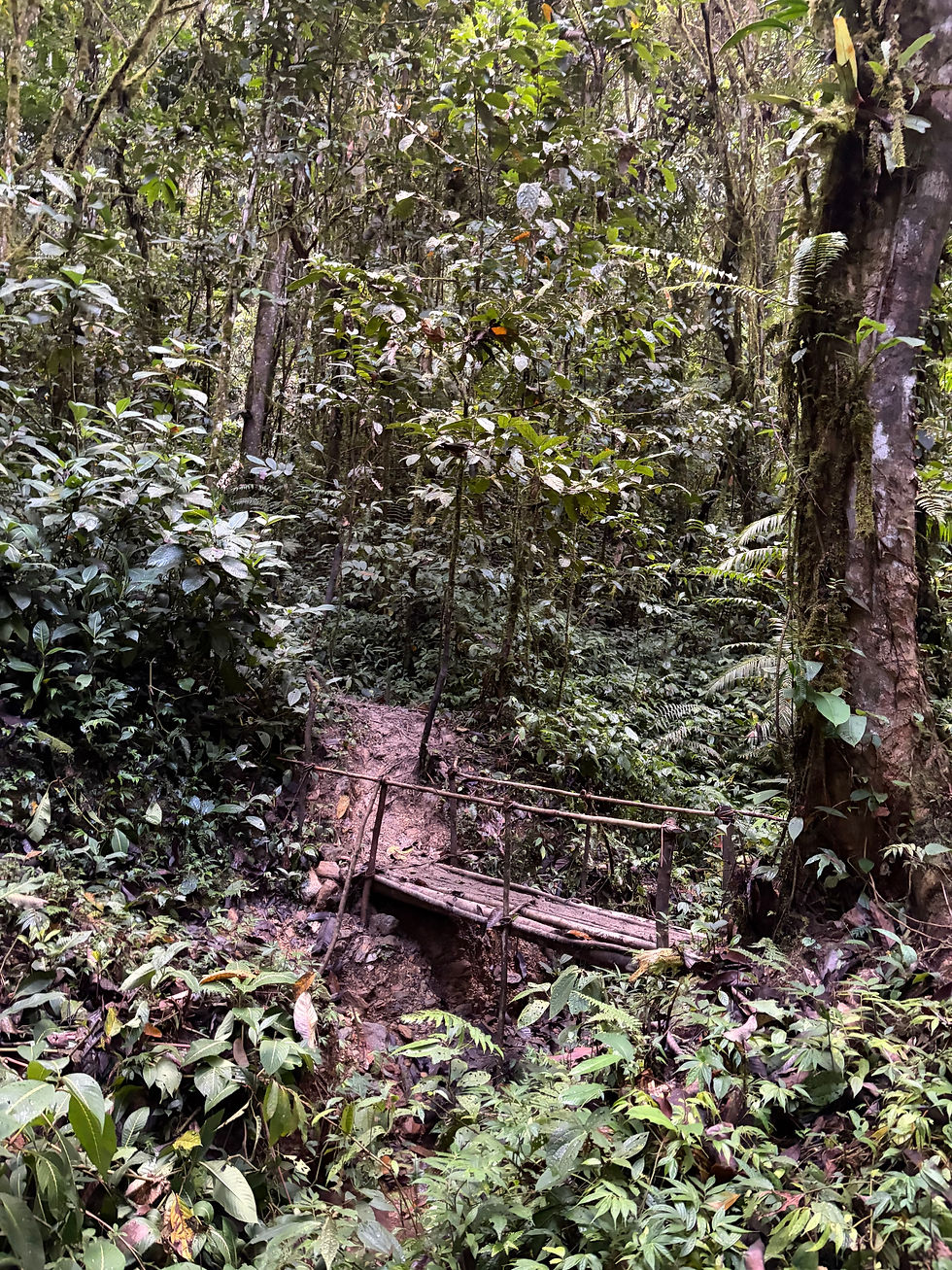
Last bridge of the day to be crossed before arriving at camp in Agulogo. Still wet. Still slippery. Still surrounded by thick lush jungle. Still humid. Still exhausted. Still wondering ''what the....''
Comments