

Kokoda - Day 1
Updated: Jul 17
Kokoda to Hoi
Distance: 10.01 km
Walking time : 4 hours 14 min
Elevation profile:

As with previous adventures it had been my intention to log each day independently. That all went askew after the first day when I forgot to record my notes from the days' activities. Thereafter I was so exhausted each evening that I only periodically recorded my thoughts. So for those reasons and others, whilst I am still individualising the days, and photo's, my recollections on any such day may be one of many from the trek in its entirety and not just unique to that particular day being shown.
Our group was 14 paying clients with an even 50/50 split in gender. Nine of the group were either related to each other or knew each other prior to the trek. They included Dammo, Jenna, Lisa, Grant, Anne, Chris, Lynda (all Melbourne based) and Kristy and Glen (Brisbane based). Of the remaining 5, there was my good friend Gareth (Sydney) myself (London), Danette from Sacramento - USA, Mo from Sydney via California, and Marty from Western Sydney, Our trekking guide, Peta hailed from the Sunshine Coast where her normal life was working in Bunnings. With 14 trekkers, a guide, a pace setter, a 2IC, 13 porters, 3 cooks, and various other trekking staff the entire group numbered approximately 35-40.
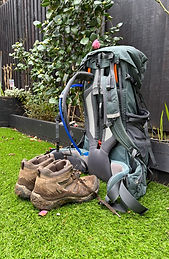
He's ready to go. He wouldn't see another bottle of water that cold for 8 days. Electing to carry all my own gear meant that pack, with water, weighed 15kg.

All the trekkers gathered in the hotel foyer at 8 am for our bus out to the airport where we sat for approximately an hour waiting for the weather to clear in Kokoda so that our plane would be able to land there. Inside the waiting area (thankfully air conditioned) you could sense an atmosphere of quiet trepidation and nerves as the reality of what we were about to do struck home with various people.
Coolest room in Port Moresby. Waiting room at TropicAir HQ. It even had a VIP lounge

Sitting in the terminal awaiting our flight to Kokoda the realisation of what was coming starts to hit home

For some reason the fortitude and determination of this single flowering plant in the car park of the airport terminal building resonated with me in regards to the qualities of character that we might be asked to show ourselves over the next 8 days. A remarkably profound thought given the state of mind at this stage

Them boots (with the possible exception of Marty's) would never be so clean again until day 9 when we were back at our hotel, trek finished, and paying 20 PGK to have them cleaned

(photo courtesy of Peta.B)
The 'plane' was a single engined Cessna 'Caravan', much used and favoured in these parts of the world for their reliability, power and cargo carrying capacities. After independently weighing everyone and their packs we were divided into two groups as the plane only had capacity for half the group.
6 of us and our guide and two porters set off for Kokoda. The 40 minute flight took us directly over the terrain we'd be spending the next eight days to walk. 40 min flight = 8 days of walking. That sounds about right for PNG and gives you an insight into the severity of the terrain.
The Cessna Caravan. Workhorse of the airways of PNG

Almost front seat views
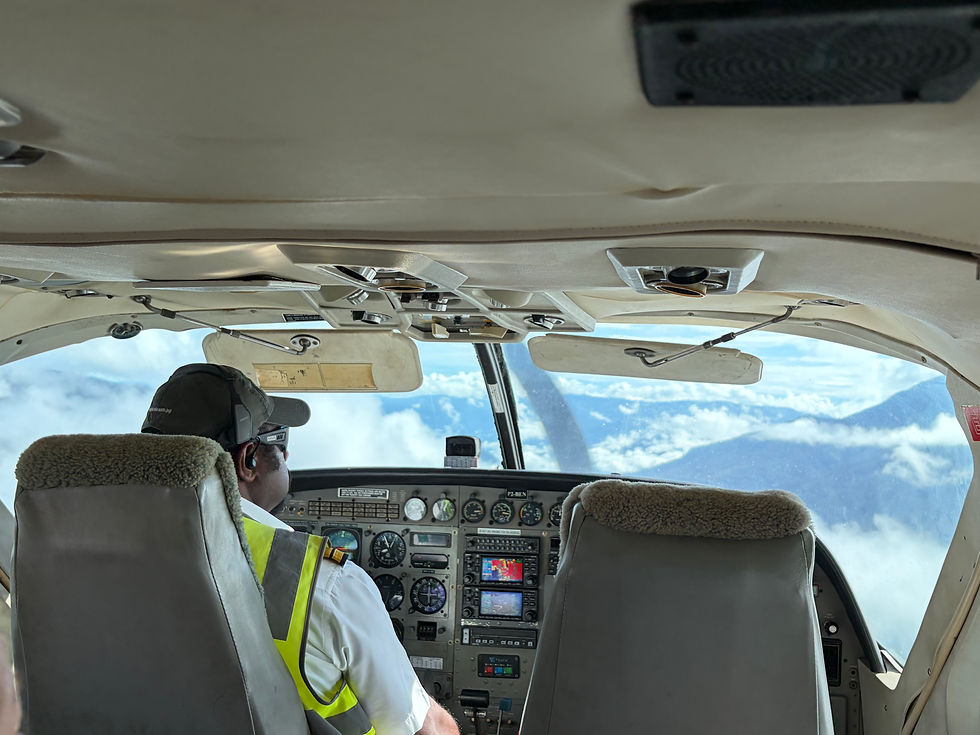
As per usual for any bush airstrip in PNG, Kokoda is a grass airfield and as per usual there were a mass of villagers there to welcome us, or to say farewell to the any one of the 5 people who were going to be on board the return flight to Port Moresby. Villagers standing airfield side is a common sight anywhere in Papua New Guinea. A 'balus' (airplane) is still a vision of wonderment for many of the locals regardless of their age. And for many, who are saying goodbye to their relatives or 'wantoks' (friends) it is an almost ceremonial atmosphere to send them off in one of these strange modern contraptions. Probably out of fear they will never see their friends or family again.
1,243 ft in the mountains of PNG makes Kokoda airstrip susceptible to weather

The humidity and heat in Port Moresby was mildly stifling. Arriving in Kokoda it was only mildly offset by the increase in altitude with the airfield being at an altitude of 1,243 ft. Stepping off the plane the memories of my time in PNG came flooding back with the dense jungle bordering the airstrip, the fragrance of the grass and richness of the earth, and the collective aroma of the crowd that had gathered to watch us land. Being in the first group, Peta herded us away from the airfield and to the Kokoda Trail Museum where we would await the arrival of the second half of our group. Given the plane had to return to Port Moresby, unload its cargo from Kokoda, re-load the second half of the group and ferry them back to Kokoda we were waiting within the compound of the museum for nearly two hours. Not an issue at all, and gave us time to explore the museum, and its close surrounds, and to relax in the shade on the carpet of lush broad leafed Buffalo grass that is so prevalent throughout PNG.
Kokoda Museum

The plinths surrounding the museum. Each telling its own story about the military battles that were fought on the trail. Interestingly, on the far right is a memorial to the Japanese who fought and died along the track (one of only two Japanese memorials I saw in the entire 8 days). When originally erected the gun barrel faced skywards. Shortly thereafter the locals decreed that as the Japanese had lost the battle it should be pointed earthwards out of respect

The offending plinth and subsequent gun placement

(courtesy of Glen.S)
A thick, lush covering of broad leafed Buffalo grass in the shade of the museum makes for an ideal place to rest as we awaited the second half of our group to arrive from Port Moresby. It was after all an 'arduous' 700 meter trek from the airstrip to the museum grounds

Flying into Kokoda is not a service offered by all trekking companies. Many others, in order to keep costs down, fly their trekkers into Popondetta which is a modern paved airstrip able to take much larger aircraft. Being closer to the coast it is also not as susceptible to closure due to the weather. The downside is that once you land there, most trekking companies then ferry you to Kokoda by open topped ex-military type trucks. A 2-3 hour journey, sitting on wooden benches, along a dirt road riddled with potholes. Not for my spine thank you.
Following the arrival of the second half of our group there was a brief talk led by Peta, focusing on the significance of the various plinths within the field surrounding the museum, and the contents of the museum itself.
Peta our guide, explaining the military history of the trail we were about to embark along. She could just as likely also be saying, '' Yes you muppets you signed up to walk from here to there''

Then we started walking. Not far, and only about 1 km up the main road of Kokoda (which surprisingly was bitumen) to a local house and garden called 'Marcella's ' where we enjoyed our first lunch on track and reputedly some of the finest home made banana bread in PNG. 'Marcella's ' was also where the group got to meet their porters and the other staff that would be assisting us on our walk.
Meeting the porters and other staff. Day-glo fluorescent and bright red ensembles made for easily distinguishable porters and guides

He be at the 'start' of the trail. The heat bouncing off that road at 2 pm was something special

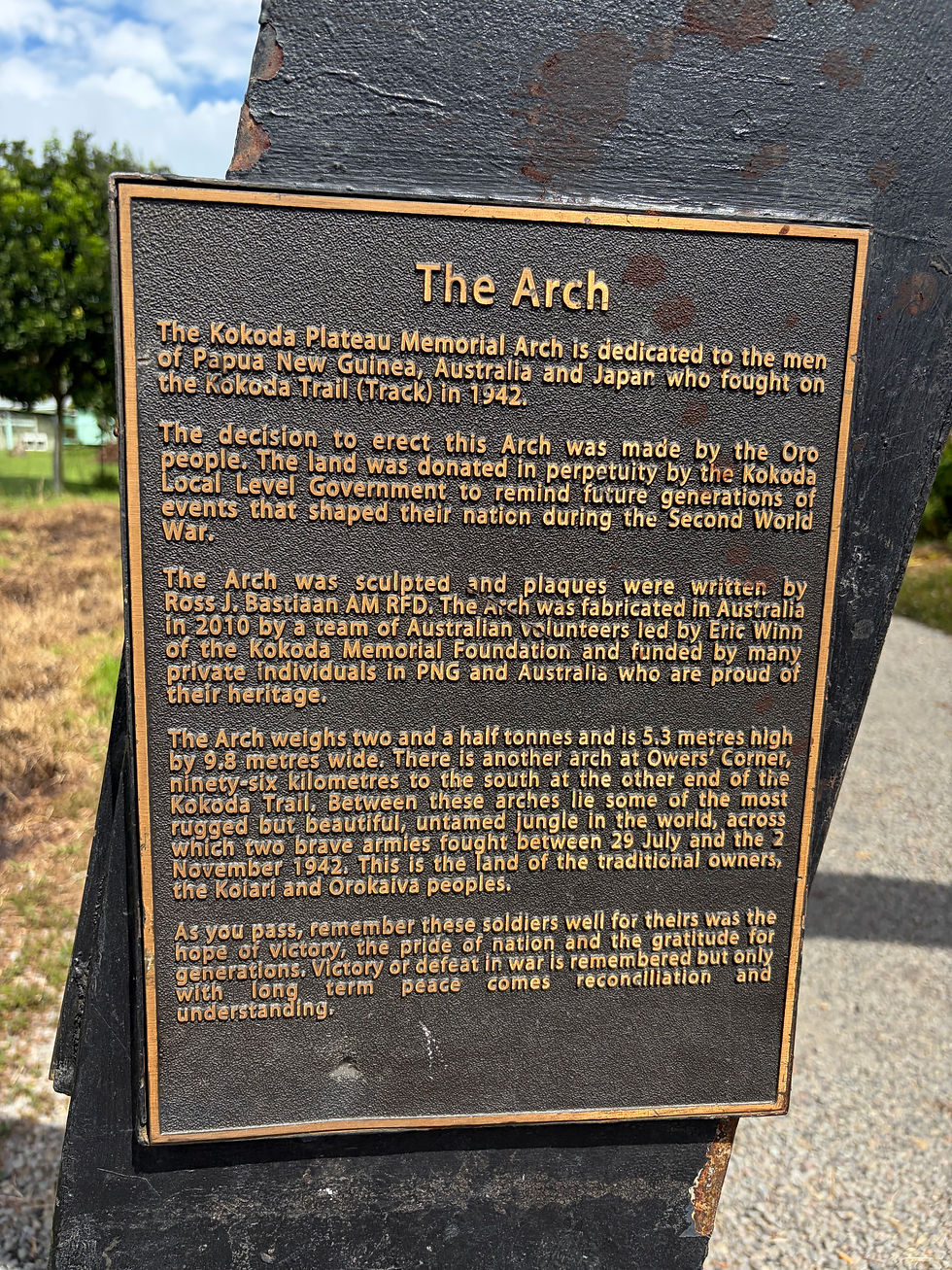
Once lunch and introductions to the group were done we set off along the road, pausing momentarily to take various photo's of the arches that signify the 'official' commencement of the track. Pretty soon the road turns into gravel and shortly thereafter into a rough 4WD track before narrowing further into a single file dirt/mud track. Our destination was Hoi. A. small village some 7 km away which took us roughly 2 hours to reach. Although the terrain was pretty benign and the slope not steep it was fairly evident by the lack of conversation that the challenge of what lay ahead was now embedding itself very firmly into the psyche of most of the group as people stayed quiet and focused on trying to look outwardly calm and confident.

Simple pleasures in a simple life. An upbringing somewhat less complicated I suspect to any of his peers growing up in the 'developed' world

The start of the trail 'proper'

Local resident along for the free ride

The first of countless creeks and river crossings we were to do over the next 8 days. Thankfully this one could be forded without us having to take off our boots. I initially tried to keep count of these crossings with the aim of filling my head with more useless data by trek end. I gave up after 6 crossings on the first day. I'd also pay good money to hear what those local children were thinking as we passed them

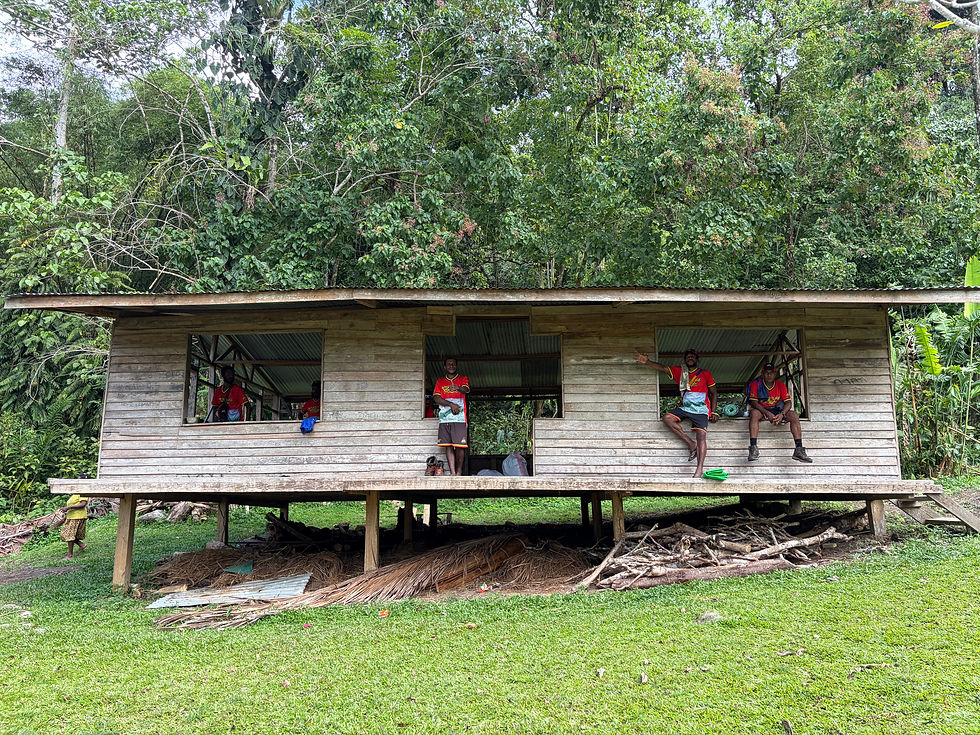
Porters hut in Hoi. These huts at our various camp sites were seemingly always an epicentre of laughter and joviality for the porters
Local fauna didn't disappoint on day 1. Nor any other day to be fair

Hoi Village. That river and its cold water became a focus of the attention of most of the group within minutes of arriving. Nothing beating a good soak and wash in a jungle creek after a day of sweat and dirt. A cold beer would've topped the day

Upon arriving into camp the routine was always the same. Locate your assigned tent (always the same numbered tent) , grab your trekking towel, and water bottles and Camelbak and head to the river (It was a shower in two camps. Although the term ''shower'' should be loosely applied) to wash and refill your water bottles in preparation for the next day. Return to the tent, change into your camp wear and head to the dining hut.
Dinner that first evening was, as it always would be, in a communal hut where we sat as a group on long benches at a long table with only our head torches to light the way. The evening meal too was pretty repetitive but a testament to the creativity of the chefs who had little to work with. A soup and then rice or pasta with a light stew. Slightly different for those vegetarians amongst the group. With nought to do post dinner. and it being pitch black, most of us retired to our tents early. On the first night my head hit my £9.95 camping air pillow at 7.20 pm, and according to reports from my fellow trekkers the next day, I was snoring by 7.25pm.
Accommodation was in 2 person tents. However we were each assigned a tent to ourselves so there was plenty of room to not only lay out sleeping bags and mattresses but also to bring in our boots and rucksack to keep them dry. Or so we thought. Sleep pattern was a disturbed one. Having gone to bed so early I recall waking at what I thought must be an early morning hour to discover it was only 10.55 pm. Woke again about 400 times during the night.
Comments