

Kokoda - Day 4
Updated: Jul 17
Templetons Crossing to Efogi (via lunch at 1900 and afternoon tea at Naduri)
Distance : 25.4 km
Walking time : 12 hours 23 min
Elevation profile:

If we thought a 5 am wake up call was a bit rude (albeit for a dawn memorial service) then getting woken at 4.30 am the following day was even ruder. Again, the early start was to ensure the group got into camp at a reasonable hour. As it turned out we should have risen an hour earlier if we were going to give ourselves any chance of making camp before night fall.
After a quick breakfast we set off at 5.26 am. The steady stream of head torches looking more like a long glow worm than 14 trekkers who had paid for the privilege to be there in the middle of a jungle, in the dark, climbing intolerably steep hills in the mud and rain

By 6.20 am the sun had risen and we had all but dispensed with our head torches. At this point the group was still closely formed. The jungle was pretty closely formed too. Thick unrelenting bushland

The beam of some trekkers head torches still visible as we trekked onwards

The jungle seemingly only getting thicker as we progressed. It is easy to understand why, when an aircraft comes down in PNG, it is almost impossible for searchers to find the wreckage

Local flora on day 4

Day 4 local flora part II

A very large part of the technical nature of the trek was navigating the labyrinth of tree roots. Wet and moss covered you had to be careful when stepping on or over them . Especially when going downhill

River crossings such as this one were a common feature of every day. Fortunately, on this occasion it was a bridge constructed from logs with a handrail, which more often than not was simply a piece of rope tied from one end to the other. Any creek or river crossing entailed a precipitous drop down into the creek or river bed, followed by an even more challenging climb out. On this day, there seemed to be an interminable number of crossings, each energy-sapping in its own way

Local villages blended so seamlessly into the surrounding bushland that you were often almost upon them before you realised they were there

A traditional home done PNG style

Local flora day 4, part III

Another pristine village that we passed during the day

Glen & Kristy. Melbourne origins and now Brisbane homed, are a couple who had lived in England for a few years. I. make mention of this fact only because they seemingly enjoyed their time there. A rarity indeed. Despite that idiosyncrasy in their characters you would be hard pressed to find a more interesting and interested couple. Slaughtering ourselves up a steep hill at one stage I tried to take Kristy's mind off the task at hand and learnt much about where she and Glen had met. Suffice to say we all have a lot to thank night clubs for. For these two, ''Century 21'' in particular.

(photo courtesy of Kristy)
The front of the group stopped to draw breath and allow the others to catch up. At times, we were strung out over more than a kilometre of track

During day 4 we passed over the highest part of the entire trail. Mt Bellamy at 7,380 ft making it 70 feet higher than the highest point in Australia , Mt Kosciusko at 7,310 ft

The 'bilum' is a much loved string bag used by the locals of both genders to carry all manner of items. Traditionally made from plant fibres and dyed various colours they are also made from animal fur. Today, many weavers also use modern synthetic materials like acrylic wool, cotton, or recycled plastic packaging for brighter colours and durability. If I had to pick one item that epitomises the soul of PNG then the bilum would be it. Beetle nut would would be close second

The scale of the jungle is best illustrated in this shot. Trees and foliage dwarfing the walkers

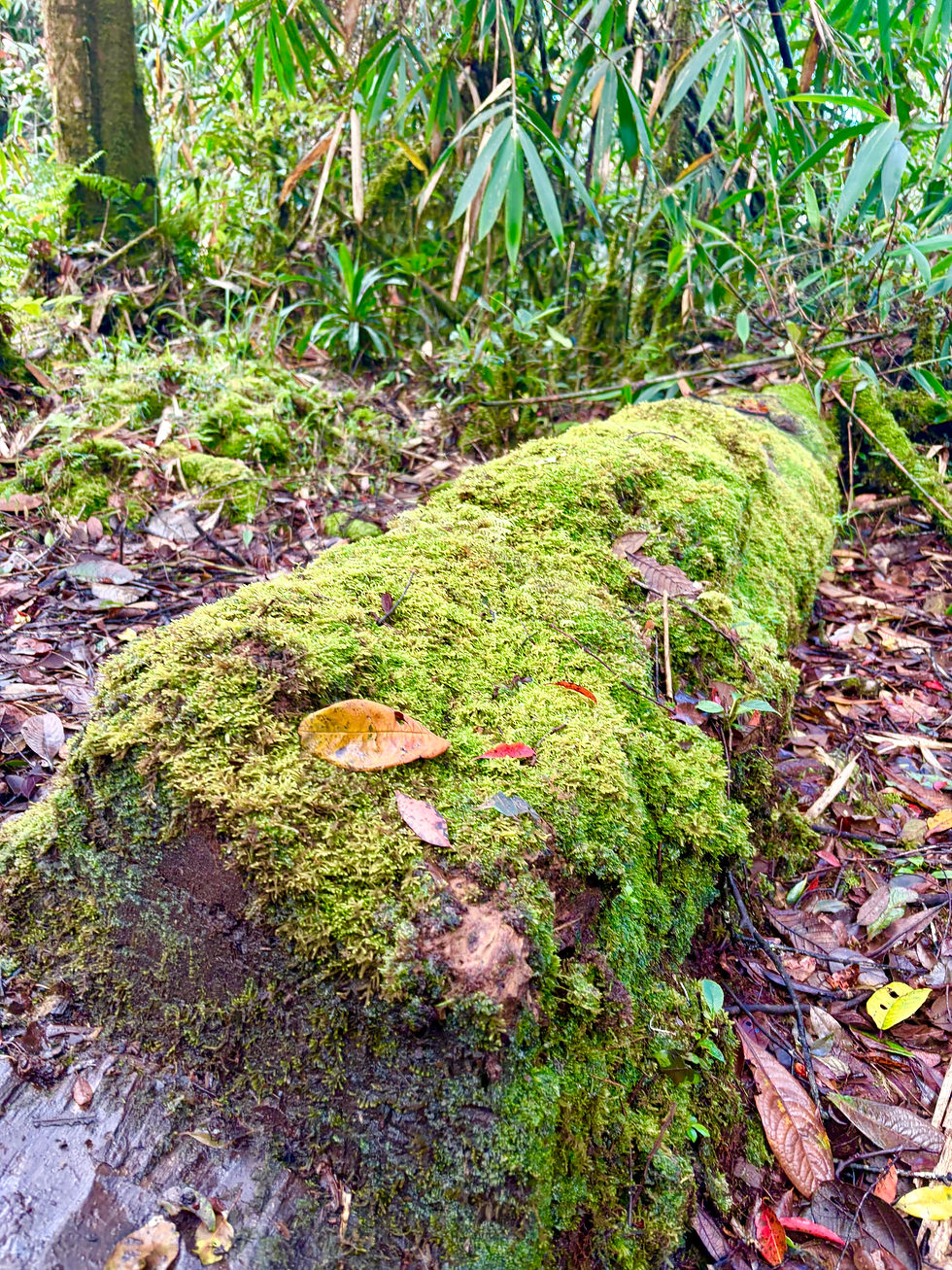
Given the moisture up this high there was little surpirse that much of the walk across the top of Mt Bellamy was through moss covered terrain
Another youth inspired question and message on a track snack

At this stage I suspect Gareth was having deep regrets about responding 'yes' to my question on Whatsapp last November if he'd be interested in doing Kokoda with me. I am not sure if it was stubborness or determination that had got him this far. Probably both. Either way, it was super impressive and just a prelude to what was about to occur

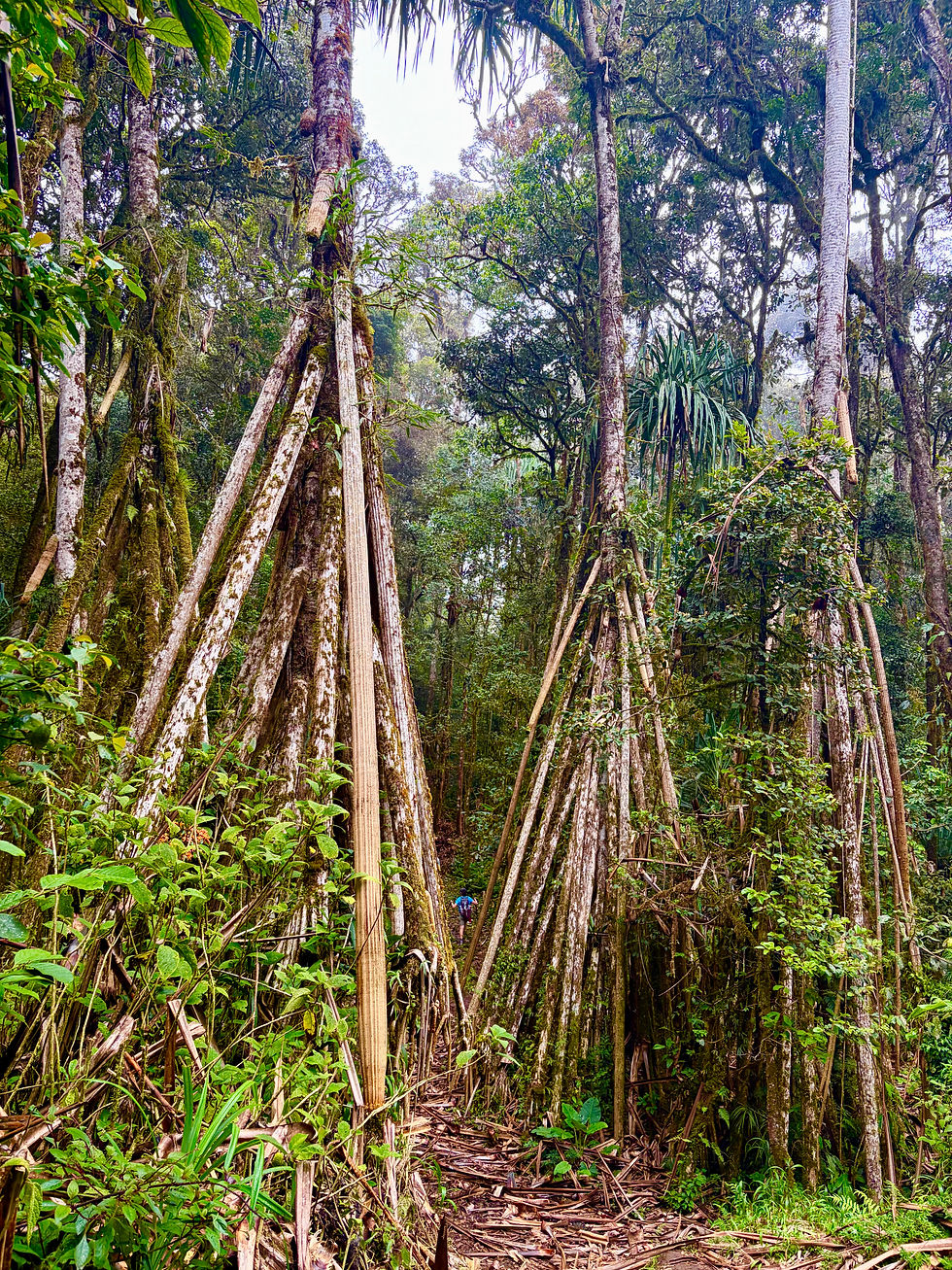
We were seemingly in the land of the giants when it came to vegetation and foliage

The scale of the vegetation best exampled by the trekker disappearing out of sight amidst all of it
Parts of the trail cut a small scar across the landscape

Bridge number 1,021 and again the porters wait patiently to guide their assigned trekkers safely to the other side

A village vegetable patch bordered on all sides by a makeshift fence in order to keep wild boar and other foragers from destroying the crops. One crop we all grew to appreciate was the banana's on sale at various points of the trail. It was an universal agreement that they were the most flavoursome banana's most of us had tasted and at just 10 Kina (£2 or AUD$4) a bunch (usually numbering 6-8 banana's) a real deal

As we entered a small village, the sound of cicadas was immense. With the enveloping mist and dampness of the air, the trees all shorn of their foliage, it felt eerily quiet and something akin to a scene from a horror movie.

Afternoon tea on Day 4 was taken at a small village called Naduri. Here, Peta took the time to engage with and speak to a local villager whose brother had been one of the Fuzzy Wuzzy Angels who helped the Australians throughout the Kokoda Campaign. The Fuzzy Wuzzy Angels were so called because of their hair and because of the important role they played in carrying injured Australian soldiers on stretchers across unforgiving terrain. They were also used as porters for food and ammunition, and there is little doubt that without their assistance, the outcome of the campaign may have been entirely different. Amusingly ,this chap wanted to know if any of us had AA batteries with us. His transistor radio had long stopped working and he was hopeful that one of us had the necessary items on us. Unfortunately we didn't. Danette proclaimed the toilets in this village best on trail and was so enthused she openly encouraged us to avail ourselves of them. I did. She wasn't wrong.

Peta's connection with the locals was obvious and very admirable

Late on the day we approached and then started to climb a waterfall that Peta had long warned us about. I had being somewhat disbelieving we'd have to walk up an actual waterfall. That disbelief was shattered when confronted with the climb in front of me. The Pocket-Rocket (aka- Lisa) took it in her stride, even though some of the steps up measured about half her actual height. For me, it was on a par with another climb that came on day 7 as one of the two steepest and most challenging climbs of the entire 8 day trek. Probably thanks to Gareth that I made it to the top in decent time as realising my suffering he patiently paced me up the climb. The walk up through the waterfall did clean the boots however. Always a positive in there somewhere. Any self pity, exhaustion or pain I was feeling was dissipated by a sharp sense of reality provided by Lisa's porter who was not only doing it in worn out sneakers, and carrying a 20-25kg pack and was also on hand to assist Lisa clamber up various chest high steps.

Climbing out of the waterfall we came across Efogi II. A smaller village that was a precursor to the larger village of Efogi about 30 mins trek away. Again, a meticulously clean compound with an abundance of young children playing and not a piece of modern technology in sight

Efogi II is also home to the only on-trail memorial to the Japanese. The story goes that one Japanese soldier who survived the conflict and returned to Japan was so ostracised by his family and community that he returned to PNG and lived with the locals for 30 years. He took it upon himself to search for, and recover the remains of Japanese soldiers who had perished on the trail and return them to their families in Japan

Again, a well kept , civic pride example of the way of life in this part of the world. Not too many satellite or cable TV disks to be seen here. In fact - none

Probably my favourite photo of the entire trip . And I didn't even take it. Here Grant gets involved with the local kids in Efogi II. I had grown up with similar aged kids and one of them still remains as my longest standing friend. To witness the interaction of my fellow trekkers with the locals, and show their appreciation of everything they (the locals) had to offer was immensely heartwarming. The simplicity of their lives, and their innate ability to derive joy from even the most basic of activities was a stark reminder of how complicated we, in the developed world, have made our lives. As Grant said to me shortly after this picture was taken..'' looking down to that play area Nick and we don't see a single piece of technology and yet look at their happiness ''

(photo courtesy of Grant)
As dusk fell at 6.20 pm, we had our last river crossing. This one required the removal of boots—just what you don't need after 12 hours on the track. The walk to the main village of Efogi was about a kilometre, just short enough to encourage us to keep our creek sandals on and walk the rest of the distance in them. This screenshot taken from a video I have of Gareth doesn't do justice to either the darkness or the wetness of the situation. You can almost see the think bubble above Anne's head behind him....''You're fkn having a laugh aren't you ? You want me to do what ? ''

The walk into Efogi marked the end of a VERY long day. We had set off at 5.20am and when I took this photo it was 6.40pm. That is a nice 13 + hour day on trail. It had rained on and off most of the day and as we entered the compound it had started to drizzle again. Dark as it was, we availed ourselves of the only shower in the camp site which like the previous one at Isurava was simply a tap perched up high in a small wooden booth. Cold stream water never felt so good. Efogi was a minor metropolis compared to any other village we had passed through or camped in. Complete with solar powered village lights it was a sight to behold. Dinner and bed couldn't come quick enough

Comments