

KOKODA - the logistics
Updated: Jul 9
Training for the Kokoda when residing in the UK was always going to be a challenge. It is hard to replicate the heat and humidity of a tropical jungle when your surrounds are suburban London in the middle of winter. At least I would be used to the wet. After all it was the wettest English January on record.
STARTING TRAINING FOR A TROPICAL JUNGLE TREK IN THE MIDDLE OF AN ENGLISH WINTER

A good friend, Scott.G had done the Kokoda two years ago and was eager to impart his experience upon me which included one fundamental piece of advice. ‘’Just do as many squats as you can every day until you leave for the trip’’.
The first part of the planning involved creating a routine. Mine was simple. Get the body used to carrying a pack with weights. Wear in a good pair of boots. Get the feet used to walking for long periods of time. Walk as many stairs and do as many squats possible. All of the aforementioned as often as possible per week.
Borrowing a pack from Scott in mid January I initially just wore it empty on a few long walks . Over the ensuing weeks I progressively loaded it with heavy books and then added some dumbbells to it, to the point it was weighing 16kg-178g on each walk. (Ironically one of the books inside the pack was the 550 page hard back tome named ‘’Kokoda ‘’ by Paul Ham.)
I am blessed that basically on my front door step is the magnificent Richmond Park. Walking to the park, doing its perimeter fence gravel track, and walking home equated to just under 20km . That ticked the box of doing long walks and getting the feet to being used to long periods of movement.
RICHMOND PARK VIEWS

RICHMOND PARK VIEWS

Aside from possibly walking on the spot inside a large sauna I was never going to be able to replicate the steamy conditions of the PNG jungle. Instead I wore as many layers of clothes as possible on each walk in an attempt to get my body used to sweating. I like to think this practical but simplistic approach held me in good stead.
My boots were a trusty pair of ASOS I had purchased a few years ago and after a few weeks of training I noticed the tread wasn’t as good as new so I purchased an exact same pair and wore them in.
I started doing squats too. In the third week of January it was 20 a day. I then increased that by 10 per week, so week two I was doing 30 a day. Week three it was 40 a day. By the time I departed for PNG I was doing 160 squats a day. Never loaded squats. Simple bend the knees to right angles and press up.
I also found a series of steps in Richmond Park that led to the restaurant and cafe at Pembroke Lodge. 66 steps up, walk along the front of the lodge, down 44 steps and through a wooded trail back to the base of the 66 steps and then up them again. By the end of my training I was doing this 3 times a week and doing 10 sets of 66 each time. With a loaded pack.
66 STEPS UP TO PEMBROKE LODGE THAT BECAME MY FRIENDS

THE STEPS AND HILL LEADING TO THE CREST OF RICHMOND HILL. MUCH USED. NOT WELL LIKED.

Interspersed with my local training was a few walks in the local Counties including Hampshire, the North Downs and Buckinghamshire.
STEPPING STONES ON THE BOX HILL WALK IN THE SURREY HILLS

Throw in a week of training in the hills around our house in Italy and by the end of April I felt I was physically ready for the trek.
WALKING ROUTES IN NORTH WEST TUSCANY

LOCAL ITALIAN HIKING VIEWS

HIKING TRAILS IN NORTHWEST TUSCANY

Little wonder too that by trek time I had lost close to 7 kg from that which I weighed when I started training in January. Representing about 8% of my total body weight since the new year. That was zero change in diet too. Weight loss occurs when you carry a laden pack it seems.
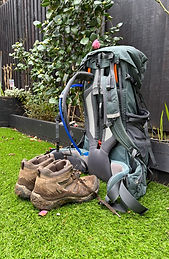
What I needed to take with me was also a bit of a logistical challenge in the sense that as I was carrying my own pack ( I had decided to turn down the services of a paid porter) I needed to ensure I was prudent in what I chose to take.
After much trialling and plenty of on-line research I got it down to the following which is a full list of went into my pack.
PACK AND BOOTS

By trainings end, I had done 33 training hikes ( if i wore a backpack with weight in it then it constituted a training hike)
Day wear -
Boots, socks, gaiters, hiking shorts, long sleeve dry-fit top, handkerchief around the neck, floppy cap, poles, mobile phone, money, my solider* (explained later)
In addition to the clothes that I wore during the day I packed the following
In my back pack
4 pairs of socks
1 pair of long hiking pants with removable lower half
1 pair of SKINS compression tights
1 pair of cotton boxer shorts
1 long sleeve quick dry active wear
1 long sleeve thermal top
1 rain jacket
1 thermal beanie
1 p air of SKINZ waterproof socks
1 pair of hiking sandals
1 sleeping bag
1 sleeping bag liner
1 air mattress
1 air pillow
1 set of ear p lugs
1 eye mask
1 metal bowl
1 set of cutlery
1 metal mug
1 wooden scrubbing brush
1 large first aid kit with every imaginable bandage and drug you can think of
2 external battery packs
1 ‘’Steripen’’ to sterilise and clean water
8 days worth of track snacks all individually packaged in zip lock bags
1 p air sunglasses
1 pair reading glasses
1 pair spare reading glasses
1 waterproof toilet paper roll carrier
1 roll of toilet paper
1 small bottle of hand sanitiser
1 roll on sun scream
1 tub of vaseline
1 head torch
8 spare batteries for head torch
3 charging cables for watch, Steripen, and phone
1 small square camping seat cushion
1 can of dry foot powder
1 first aid kit with enough drugs to keep a small village pain free for a year
1 trekking towel
1 chamois cloth
I was fastidious about everything to the point that I individually weighed every single item that went into my pack and chose to carry what I perceived to be the bare minimum. The directors of the trek had suggested to those that were carrying their own gear to make sure that excluding water our packs should only weigh a maximum of 9 kilograms. You can imagine my delight then when everything I weight totalled just 9 kgs. Then my dismay, when I realised I also had to add the weight of the back pack which was exactly 2 kg. So 11 kg in total. Throw in 3 litres of water and I was looking at 14-15 kgs. Add poles and it was closer to 15 kg. Throw in my boots and the whole weight I was asking my body to carry was closer to 16 kg. With the mud that attached itself to my boot each day and I was probably looking at close to 17 kgs of external weight.
The getting there bit
Getting to Port Moresby for a May 3 meet up with the trekking company entailed two basic options. Fly direct to Port Moresby from the UK via Singapore. Or fly to Brisbane in Australia and then up to Port Moresby. Wise wifey, Kathryn, suggested that given the importance of putting my body in the best place for the walk, stepping off a long haul 24 hour flight from cold wintry London into the heat of Port Moresby and then setting off walking the trail the next day was probably not the wisest thing to do. Instead, she recommended going via Brisbane, having 2-3 days there to let my body re-set and then head up to PNG. Great advice and heeded.
So, it was a 13 hour trip to Singapore, 2 hour lay over, and 7 hours to Brisbane. 26 hours door to door.
Arriving Thursday night into Brisbane I set about to stretch the legs and walked the streets of inner Brisbane CBD area until I found a delightful wine bar and sat myself there to ponder the delights of the past 24 hours of airline air and food. Friday I got myself a remedial massage, enjoyed a leisurely lunch with a good friend, and an even more leisurely dinner with another good friend who seemed hell bent on ignoring my hesitancy in imbibing too much excess ahead of the walk and dropped me off at my hotel at 1 am rather pished. Saturday the same friend and his wife took me for a leisurely lunch and stroll in Brisbane and then I spent the afternoon on my bed recovering from both the long flight and the previous 24 hours of leisurely lunches and dinners. Sunday morning it was up early and out to the airport where I would meet my good friend and trekking companion Gareth.T in readiness for our 9 am flight to Port Moresby.
Brisbane views


Rendevouz with Mr Gareth at Brisbane airport....moments later we were gateside eyeing up the rest of the ''strangers'' who we were to trek with us. Thankfully, despite our concerns, none of them seemed to be wearing sandals.

Comments